Goran Golubović
In a world flooded with AI hype, the real question is no longer who adopts artificial intelligence the fastest, but who truly controls the data, models, and decisions it produces...


Goran Golubović
Director


While companies on professional networks compete to showcase how they use artificial intelligence, trust in the digital space - and in AI-related content itself - is simultaneously eroding. Professional networks such as LinkedIn, once places for serious exchange of knowledge and business insights, increasingly resemble arenas of hyperproduction of generic, self-promotional content.
Judging by the posts, we seem to live in an age of inflation of AI experts and solutions. Never have there been more specialists and phenomenal AI solutions. Yet in reality - there have never been fewer truly integrated AI implementations.
A few days ago, at an official reception, my former boss, one of the executives of a large regional financial institution, asked me a direct question:
“Is that sovereign AI solution you keep writing about on LinkedIn actually a real thing, or just another wave of marketing?”
The question was not cynical (well, knowing him - perhaps a little), but above all it was sincere. And within that question lies the essence of the problem.
Because professional networks are overloaded with generic posts, aggressive promotion, and self-proclaimed AI experts, an environment is created in which even serious, operational solutions encounter skepticism in practice. When we can no longer distinguish real insights from noise, trust begins to erode - even in genuine, successful, and potentially revolutionary AI systems.
If trust in the digital space and professional networks is shaken, how can we expect people to trust AI systems that increasingly make decisions on our behalf?
In this context, sovereign artificial intelligence becomes a strategic topic. The next phase of the AI revolution will not be built on hype, but on trust.
Artificial intelligence has become a standard element of corporate presentations, strategic plans, and almost every serious digital initiative.
However, behind the wave of enthusiasm and public announcements about “AI transformation,” an important question emerges: who actually controls this intelligence?
Where are the data stored? Who has access to business logic, data, and models? Who is responsible when a system makes a mistake - and how do we even know that a mistake has occurred?
The first phase of the AI revolution focused on speed of implementation and demonstration of innovation. The second phase, which we are entering now, focuses on accountability, regulation, and digital sovereignty. For Europe, this is no longer only a technological issue - it is a strategic imperative.
Digital and AI sovereignty are becoming key priorities for the European Union for 2026 and the years beyond. Europe wants to be more than a user of global technology platforms. It wants to become a creator of its own digital infrastructure.
This is confirmed by regulatory frameworks such as the EU AI Act, as well as broader political and institutional initiatives aimed at strengthening Europe’s technological capabilities.
Recently, at the Digital SME Summit organized by the European DIGITAL SME Alliance and held at the European Parliament in Brussels, the sovereign AI solution KVARK - developed by the company Egzakta - was presented. The event was attended by European policymakers, ministers, members of the European Parliament, innovators, and business leaders.
Presenting a regional solution in such an environment was not only a professional recognition but also proof that sovereign artificial intelligence is not merely a theory - it is already an operational reality.
Europe’s digital future will depend on reliable, sovereign, and innovative solutions. Companies like Egzakta that invest in such systems today are not simply following trends - they are shaping Europe’s new technological architecture.
The expansion of generative artificial intelligence has led to the mass integration of AI tools into business processes. SaaS models have enabled rapid deployment of solutions, while global cloud platforms have offered levels of scalability that were previously impossible.
Many organizations have integrated large language models and other AI systems without clearly defined data governance policies. They often lack precise understanding of where their data is processed and do not maintain full control over their models. AI has become a functionality - but not yet a strategic infrastructure.
Most dominant AI models and platforms originate outside Europe. They offer speed and technological advantage, but they also raise the question of strategic dependency.
If data is the foundation of the modern economy, then control over data means sovereignty.
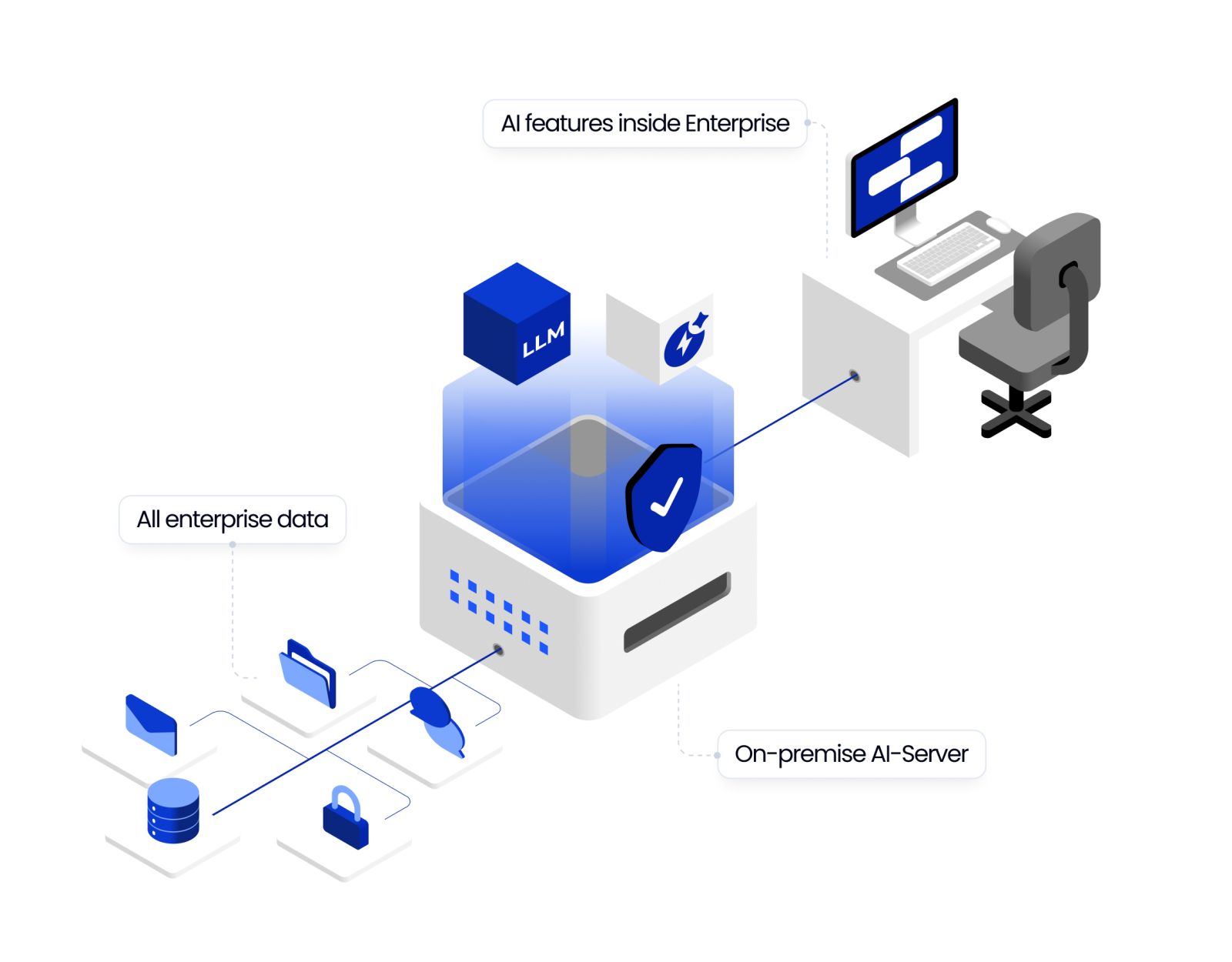
This is why more organizations are choosing hybrid or fully on-premise implementations for sensitive processes. Sovereign AI means that infrastructure, models, and data remain under the control of the organization or the state, in accordance with legal frameworks.
This is not a step backward. It is a sign of technological maturity.
In the first phase of the AI revolution, the advantage belonged to those who implemented new tools the fastest. Speed was the key, and the focus was on experimentation and visible results.
However, as the technology matures and becomes deeply integrated into business and regulatory systems, the next phase requires a different approach.
The advantage will now belong to those who build trust - among regulators, partners, clients, and employees. Europe, with its strict regulatory framework, has the opportunity to turn this rigor into a competitive advantage. Instead of passively using global platforms, it can develop sovereign, secure, and compliant systems that ensure control over data and processes.
Artificial intelligence is no longer just a technology that brings speed and visibility. The next phase requires structure, accountability, and strategic thinking. In a world where data has become the new currency, digital sovereignty becomes a key element of economic and institutional security.
Ultimately, AI becomes a question of trust and control - and those who understand this will gain a real competitive advantage.


 Serbian(Srpski)
 English(Engleski)